


Table of Contents
- The Case for Natural Materials in Lighting Design
- Environmental Benefits and Sustainable Lighting Materials
- Rattan Lighting: Warmth and Organic Form
- Wooden Lighting Fixtures: Durability Meets Natural Beauty
- Light Diffusion and the Art of Soft Illumination
- Creating Warm Ambiance and Inviting Spaces
- Practical Considerations: Care, Installation, and Longevity
- Conclusion
- Frequently Asked Questions
Last Updated: October 6, 2026
The Case for Natural Materials in Lighting Design
Why choose natural materials for lighting? The answer lies in a simple shift: moving from industrial, mass-produced fixtures to pieces that breathe with warmth, texture, and authenticity. Rattan, bamboo, and wood soften harsh shadows and create an atmosphere synthetics struggle to replicate.
At Nuits, we curate lighting that combines sustainable design with genuine emotional impact. When you choose natural materials for lighting, you invest in pieces that age beautifully, perform reliably, and tell a story.
This guide explores why natural materials have become the preferred choice for design-conscious homeowners across the Benelux region, and how to select the right fixtures.
Environmental Benefits and Sustainable Lighting Materials
Most articles treat 'natural' and 'sustainable' as synonyms. They are not.
The table below compares common lighting materials on those dimensions, a starting point for questions to ask a supplier, not a verdict on any single material.
| Material | Renewability | Processing intensity | Typical transport footprint | Expected lifespan (indoor) | Repairability | End-of-life |
|---|---|---|---|---|---|---|
| Rattan | Fast-growing vine, harvested without felling the host tree | Low to moderate (steaming, bending, sometimes lacquering) | Often high, most rattan is grown and worked in Southeast Asia | 10-20 years | Moderate, re-weaving possible but rarely offered | Biodegradable if untreated; treated finishes slow decomposition |
| Bamboo | Very fast-growing grass, harvestable in 3-5 years | Moderate (splitting, laminating, sometimes bleaching) | Often high, similar to rattan | 10-20 years | Moderate | Biodegradable if untreated |
| Solid wood | Slow-growing; renewability depends entirely on forest management | Low to moderate (drying, planing, oiling or lacquering) | Varies hugely, local species vs. tropical hardwoods | 20-50+ years | High, refinishing and re-oiling are routine | Reusable, repairable, or compostable |
| Paper | Fast-growing pulp, but often bleached | Moderate to high (pulping, bleaching, printing) | Low to moderate | 5-15 years | Low, tears are hard to disguise | Recyclable if uncoated; compostable |
| Linen | Flax is a low-input crop | Moderate (retting, spinning, weaving) | Low to moderate | 10-20 years | Low to moderate | Biodegradable and recyclable |
| Glass | Abundant raw material | High (melting requires significant energy) | Low, often produced regionally | Effectively indefinite | High, chips can sometimes be polished out | Infinitely recyclable without quality loss |
Three patterns stand out. First, renewability and low impact are not the same thing: bamboo grows back in a few years, but the energy and chemicals used to turn it into a stable shade can outweigh that advantage.
What certifications can and cannot tell you
Several certification schemes appear on lighting and furniture packaging. FSC and PEFC address forestry management for wood and paper products. EU Ecolabel covers broader environmental criteria. Fairtrade and similar schemes focus on labour and producer conditions rather than environmental impact.
What these certifications can establish: that a defined set of criteria was met at the point of certification, and that the claim was independently audited. What they cannot establish: the total footprint of the finished fixture, the conditions at every tier of the supply chain, or whether the material was the best available choice.
The durability argument, quantified
A fixture built to last 20 years creates far less waste than replacing a cheaper synthetic piece every three years, roughly a six-to-one reduction in embodied material. Natural materials support this because they age rather than fail: wood develops patina, rattan darkens slightly, linen softens. The wear point in almost every natural-material fixture is the electrical assembly, socket, wiring, and driver, not the shade. Choosing fixtures with standard, replaceable components is one of the most effective environmental decisions you can make.
Rattan Lighting: Warmth and Organic Form
Rattan brings distinctive warmth to any interior.
The Éclat Rotin hanglamp exemplifies this approach: its open-worked rattan design casts intricate shadows while the material glows warmly under illumination. Rattan's light golden-brown tone complements both minimalist and bohemian interiors.
Rattan lighting works well in dining areas and living rooms where you want ambient light without harsh glare, and its texture creates visual interest even when the light is off.
One practical consideration: rattan needs occasional dusting, and extended direct sunlight can cause fading. Placement away from south-facing windows preserves its colour and structural integrity.
Wooden Lighting Fixtures: Durability Meets Natural Beauty
Wood brings solidity and timeless appeal to lighting design. Unlike trendy materials that feel dated within years, wooden fixtures age into their aesthetic, developing patina and character.
The Lustre et Noyer hanglamp combines walnut accents with stone elements, contrasting organic wood warmth with mineral coolness.
Quality wood resists warping and maintains structural integrity for decades, making wooden pieces genuine investments rather than consumables.
Different wood species bring different qualities: lighter woods like ash and oak feel bright and airy, while darker woods like walnut add richness and sophistication.
Installation follows standard procedures, and many designs work equally well in rental apartments as permanent homes.
Light Diffusion and the Art of Soft Illumination
One of the most compelling reasons why choose natural materials for lighting is their superior light diffusion.
When light passes through rattan or woven linen shades, it spreads across a wider area rather than concentrating in a bright point.
Paper and linen shades filter light through their natural weave for warm, even illumination that feels organic rather than artificial. Frosted or textured glass provides diffusion while maintaining transparency and elegance.
Creating Warm Ambiance and Inviting Spaces
Natural materials create warmth in two ways: through their inherent colour tones and through how they interact with light. The golden-brown hues of rattan and wood warm a space, while their textures add visual softness.
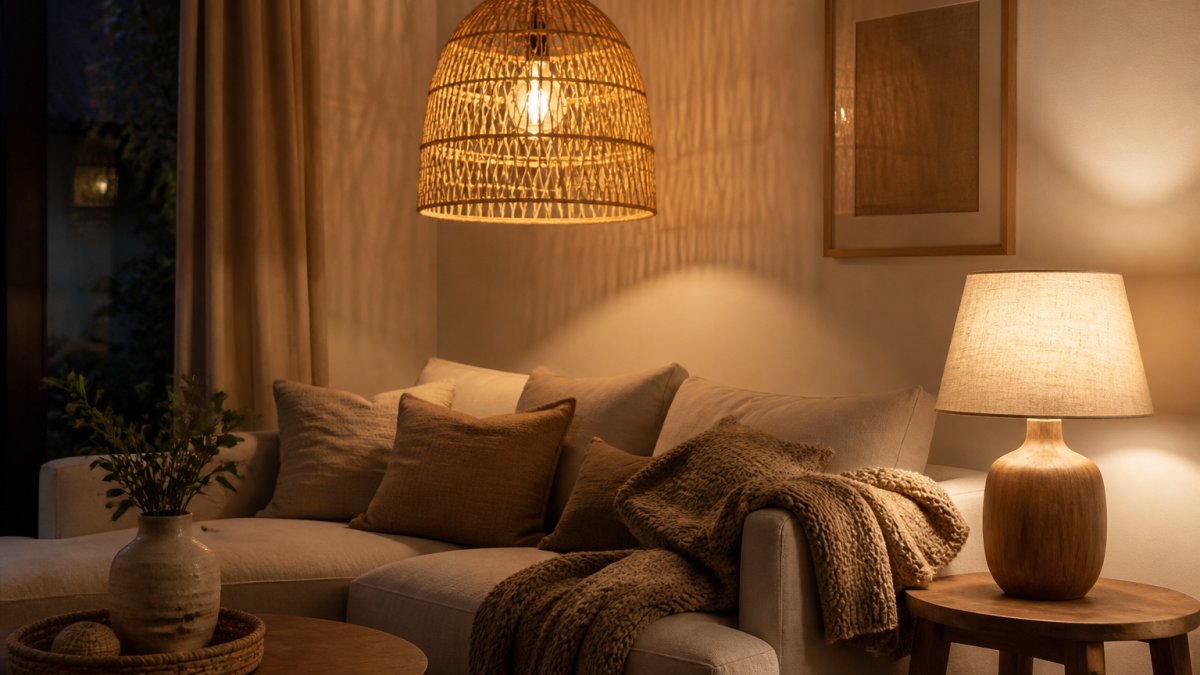
Ambient lighting from natural-material fixtures creates a tranquil atmosphere synthetic lighting rarely achieves. The Équilibre vloerlamp, with its bamboo and canvas construction, exemplifies this, a serene, zen-inspired mood suited to meditation or relaxation areas.
Warm ambiance extends beyond aesthetics into psychological comfort: spaces lit with warm, diffused light feel calmer and more intimate than those with bright, cool-toned illumination.
The key is layering.
Practical Considerations: Care, Installation, and Longevity
Natural materials are forgiving, but not indifferent to their environment. The difference between a rattan pendant that looks new after a decade and one that sags and fades within three years usually comes down to placement, moisture, heat, and cleaning.
Room suitability at a glance
| Room | Well suited | Use with caution | Avoid |
|---|---|---|---|
| Living room | Rattan, wood, linen, paper, glass | Paper near open fires | , |
| Dining room | Rattan pendants, wood, glass | Linen directly above a hot hob | Paper over cooking surfaces |
| Bedroom | Linen, paper, wood, frosted glass | , | , |
| Kitchen | Glass, sealed wood, metal-and-wood combinations | Rattan and linen near the hob or sink | Untreated paper, unsealed rattan over steam |
| Bathroom | Sealed wood, glass, treated rattan | Linen and paper in high-humidity zones | Untreated wood and rattan directly over a shower or bath |
| Hallway / entry | Wood, glass, rattan | , | , |
Moisture, heat, and humidity
Wood and rattan are hygroscopic, they absorb and release moisture with the surrounding air. In a bathroom or unventilated kitchen, that cycling causes swelling, joint separation, and eventually mould in the weave. For a natural-material fixture in a wet room, choose a sealed or lacquered finish and keep it at least a metre from the shower or bath.
Heat is the other constraint. Incandescent and halogen bulbs run hot enough to scorch paper and linen shades and dry out and crack rattan over time. LED bulbs run cool and are the practical default for any natural-material shade.
Cleaning without damaging the finish
- Rattan and bamboo: dust weekly with a soft, dry cloth or a vacuum brush attachment on low suction. For deeper cleaning, wipe with a cloth barely dampened in water and mild soap, then dry immediately. Never soak.
- Wood: dust with a dry microfibre cloth. Re-oil untreated or oiled finishes once or twice a year with a suitable wood oil to prevent drying and cracking. Avoid silicone-based polishes, which build up and dull the surface.
- Linen and paper: dust with a soft brush or a vacuum on the lowest setting. Do not use water, it will mark the material. Creases in linen shades can often be relaxed with a hand steamer held at a distance, but test on a hidden area first.
- Glass: wipe with a damp cloth and a non-ammonia glass cleaner. Ammonia can damage some coated or frosted finishes.
Installation and rental-friendly options
Most natural-material fixtures use standard electrical connections, so installation follows normal procedures for the fixture type. Pendant and wall-mounted pieces should be installed by a qualified electrician, particularly in older properties. Table and floor lamps need only a standard outlet.
For renters, the practical hierarchy is: table and floor lamps first (no modification), then plug-in pendants with a ceiling hook, then hardwired pendants installed with the landlord's permission. A fixture you can remove and take to your next home is both a financial and an environmental win.
Longevity and repair
With normal indoor care, wood and rattan fixtures commonly last 15-20 years or more, and glass components effectively indefinitely. The parts that fail first are almost always electrical: the socket, wiring, or LED driver. Because these are standardised, they can usually be replaced independently of the shade, so ask a supplier whether replacement parts are available before you buy.
Signs that a natural-material fixture needs attention:
- Rattan or bamboo beginning to sag or separate at the weave joints, usually a sign of moisture cycling.
- Wood developing fine surface cracks, often dryness; re-oiling may resolve it.
- Linen or paper shade discolouring near the bulb, check wattage and bulb clearance.
- Flickering or intermittent operation, an electrical issue, not a material one; replace the driver or socket rather than the whole fixture.
Conclusion
Choosing natural materials for lighting transforms more than just how your space looks, it changes how it feels. From the soft diffusion of rattan to the enduring warmth of wood, these materials create environments that feel intentional, comfortable, and genuinely inviting. At Nuits, we believe lighting should do more than illuminate; it should inspire. Our collection of natural-material fixtures, including the Équilibre vloerlamp with its calming bamboo and canvas design, the Éclat Rotin hanglamp's organic warmth, and the Lustre et Noyer's elegant contrast, combines sustainable craftsmanship with emotional impact.
Frequently Asked Questions
What natural materials are most commonly used in lighting fixtures?
Rattan, bamboo, wood, paper, linen, and frosted glass are the primary natural materials used in modern lighting design. Each offers distinct aesthetic and functional properties. Rattan creates open, woven patterns that diffuse light organically. Bamboo provides strength and a minimalist aesthetic. Wood adds warmth and durability, while paper and linen offer soft light diffusion. Frosted glass combines clarity with gentle light scattering, creating ambient lighting without harsh glare.
Are natural-material lighting fixtures truly sustainable?
Natural-material lighting can be sustainable when sourced responsibly from fast-growing plants or certified forestry. Look for fixtures made from renewable resources and manufacturers committed to ethical sourcing. Durability matters too, a well-made wooden or rattan fixture that lasts decades has lower environmental impact than cheaper alternatives replaced frequently. End-of-life recyclability also counts; natural materials decompose or can be repurposed more easily than synthetic alternatives, reducing landfill burden.
Will natural-material lighting work in a rental apartment?
Yes. Many natural-material lighting fixtures from Nuits are table lamps and floor lamps that require no permanent wall installation. The Éclat Rotin hanglamp and Équilibre floor lamp, for example, can be hung from existing ceiling hooks or placed on surfaces without modification. When you move, simply take them with you. This flexibility makes natural-material lighting ideal for renters seeking to personalize their space without losing their security deposit.
How do I maintain natural-material lighting fixtures?
Maintenance depends on the material. Dust rattan and wooden fixtures regularly with a soft, dry cloth to prevent buildup. Avoid direct water exposure unless the fixture is specifically designed for moisture-prone areas. For linen or paper shades, gently vacuum with an upholstery attachment or use a soft brush. Check electrical components periodically for wear. Proper care extends longevity significantly, many natural-material fixtures last 10+ years with minimal attention, making them a worthwhile investment.

