


Table of Contents
- 2026 Dining Room Lighting Trends and Forecasts
- How to Choose Dining Room Pendant Size
- Dining Room Lighting Height Guidelines
- Top 5 Pendant Lamps for Your Dining Area
- Choosing the Right Color Temperature for a Cosy Atmosphere
- Smart Home Integration for Your Dining Room Lighting
- Maintenance and Cleaning for Long-Lasting Pendant Lamps
- Frequently Asked Questions
Last Updated: September 14, 2026
2026 Dining Room Lighting Trends and Forecasts
The best pendant lamps for dining area 2026 balance sculptural form with technical precision: natural materials and warm, dimmable light that flatters food and conversation.
Handwoven bamboo, travertine stone, walnut accents and ribbed opal glass now dominate design floors. Warm white output in the 2200K to 2700K range has replaced the stark 4000K fixtures that made dining rooms feel clinical.
Three forces drive this: the mainstreaming of Japandi and bohemian interiors, LED technology that finally dims smoothly at low output, and buyers treating lighting as a long-term purchase.
How to Choose Dining Room Pendant Size
Choosing dining room pendant size comes down to two measurements: fixture diameter relative to table width, and drop height above the tabletop. Get these right and even simple lamps look intentional.
Measuring Your Table and Room
Measure your table's width, then subtract roughly 30 centimetres to find your maximum fixture diameter. A single pendant should span about one-third of the table's width, for a 90 cm table, around 30 cm wide.
Room dimensions matter too: in a compact nook, one medium pendant beats a cluster of small ones; in open-plan spaces, a larger statement piece anchors the dining zone.
The Rule of Three for Pendant Groupings
Odd numbers read better than even ones: three pendants in a row suit a long rectangular table, three in a triangle suit a round one. Space them 60 to 75 centimetres apart centre-to-centre, keeping each fixture identical.
| Table Width | Single Pendant Diameter | Grouping Option |
|---|---|---|
| 80-100 cm | 25-35 cm | One medium pendant |
| 100-140 cm | 35-45 cm | Two or three small pendants |
| 140-180 cm | 45-60 cm | Three pendants in a row |
| 180 cm+ | 60 cm+ | Three to five pendants |
Dining Room Lighting Height Guidelines
Dining room lighting height guidelines are simple: hang the bottom of the fixture 75 to 85 centimetres above the tabletop, keeping sightlines open while placing light close enough to flatter faces and food.
Adjust for your ceiling: standard ceilings suit the 75 to 85 cm range, while vaulted or double-height ceilings need a longer adjustable cord so the fixture still sits at eye-friendly height.
Over a kitchen island, 90 to 100 centimetres works better because people stand there; over a dining table, people sit, so the light comes lower.
Ceiling clearance matters as much as table clearance: leave at least 2.1 metres between the floor and the fixture's lowest point. On a low ceiling, a semi-flush mount may serve you better than a pendant.
Top 5 Pendant Lamps for Your Dining Area
Every pick below comes from the Nuits collection, tested for build quality and light output.
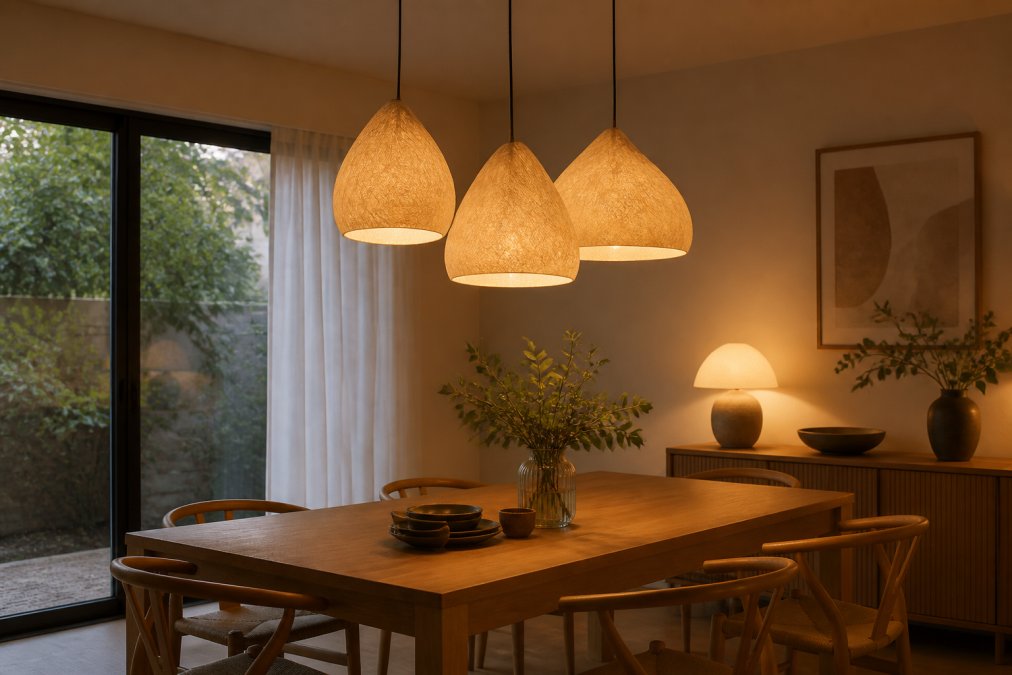
1. Hélène - Hanglampen: The Organic Statement
The Hélène is our top pick for most dining rooms. Ribbed opal glass diffuses light softly, walnut accents add warmth plain glass lacks, and the pumpkin-inspired silhouette reads as sculpture when off and glows evenly when lit.

At €159.00, it suits tables from 100 to 140 cm wide; pair two for a longer table.
2. Lustre Naturel Élégance - Hanglamp: Handwoven Warmth
Handwoven wood veneer gives the Lustre Naturel Élégance a texture no moulded shade can match, and its warm diffusion flatters a dinner table in art-deco and modern interiors.
At €252.95 it's the priciest pick, earning that through craftsmanship rather than size, best for buyers who want a centrepiece.
3. Lustre et Noyer - Hanglamp: Modern Stone and Wood
Stone and walnut shouldn't work together. Here they do. The Lustre et Noyer pairs a crisp stone frame with organic walnut accents, creating contrast that feels deliberate rather than busy.
At €122.95, it's the value pick for a designer look without the designer price, suiting rectangular tables especially well.
4. Lune Épurée - Hanglamp: Minimalist Japandi
If your dining room leans Japandi or Scandinavian, the Lune Épurée is the obvious fit: clean lines, subtle profile, nothing competing for attention. At €97.95, it's the most accessible entry into the collection.
5. Tissé Naté - Hanglamp: Bohemian Shadow Play
Handwoven bamboo turns this fixture into a light projector: the weave throws a patterned shadow across the ceiling, transforming the room's mood after dark.
At €82.95, it's the lowest-priced and most characterful pick, available in four sizes to scale to your table. The shadow effect is strongest with a warm, dimmed bulb, so pair it with a dimmable LED rather than a bright fixed output.
| Lamp | Price | Best For | Standout Detail |
|---|---|---|---|
| Hélène | €159.00 | Most dining rooms | Ribbed opal glass, walnut accents |
| Lustre Naturel Élégance | €252.95 | Statement centrepiece | Handwoven wood veneer |
| Lustre et Noyer | €122.95 | Designer look on a budget | Stone frame with walnut |
| Lune Épurée | €97.95 | Japandi and Scandinavian rooms | Minimalist profile |
| Tissé Naté | €82.95 | Bohemian and cosy spaces | Bamboo shadow projection |
Choosing the Right Color Temperature for a Cosy Atmosphere
Colour temperature is measured in Kelvin and decides whether your dining room feels warm or clinical. For a cosy atmosphere, aim for 2200K to 2700K, the warm white range that mimics candlelight. Above 3000K, light turns neutral then cool, flattening skin tones and dulling food; cool white belongs in offices, not over a dinner table.
But Kelvin alone is not enough in 2026. Three other specifications decide whether a warm pendant looks good over a set table.
CRI: Why 80 Isn't Enough Over Food
Colour Rendering Index (CRI) measures how faithfully a light source shows colour, on a scale up to 100. Most budget LED bulbs sit at CRI 80, fine for a hallway, disappointing over a plate, where reds dull and greens grey out. For a dining area, look for CRI 90 or higher; it costs a few euros more per bulb and is the most noticeable upgrade after dimming (Light Sources).
Flicker and Dimming Quality
Cheap LED drivers flicker at low dim levels, invisible on a spec sheet, obvious at a candlelit dinner. Two numbers matter: dimming range and flicker percentage. A good driver holds steady down to 5% or even 1% of output; a poor one buzzes, steps, or drops out below 20%. With an integrated LED, ask the seller for the dimming curve; with replaceable bulbs, choose a quality dimmable bulb.
Matching Kelvin to Your Shade Material
Colour temperature and shade material interact. The natural-material pendants below behave differently under the same bulb:
- Ribbed opal glass (like the Hélène) diffuses evenly and holds 2700K without colour shift, the safest choice for a neutral warm glow.
- Handwoven wood veneer (like the Lustre Naturel Élégance) warms the light further; a 2700K bulb reads closer to 2400K through the weave, so don't go below 2400K or the room turns amber.
- Bamboo weaves (like the Tissé Naté) cast patterned shadows that are strongest at 2200K-2400K. A 3000K bulb washes the pattern out.
- Stone and walnut (like the Lustre et Noyer) reflect light cleanly; 2700K keeps the walnut warm without making the stone look yellow.
Brightness and Layering
Brightness matters as much as temperature: aim for roughly 400 to 600 lumens per fixture, then make it dimmable so one fixture serves both a bright family meal and a low, intimate dinner. If your pendant is the only light source, add a floor or table lamp on a separate circuit.

Smart Home Integration for Your Dining Room Lighting
Smart control is the angle most lighting guides skip, and it's where a dining room gains the most. Connecting pendants to a smart dimmer lets you set scenes: bright for homework and breakfast, warm and low for dinner parties.
The practical route is a smart bulb or dimmer module that works with your existing system. Most modern LED fixtures accept standard dimmable bulbs, so you keep the fixture you love and add control on top, but check hub compatibility first, since some budget dimmers buzz with certain LED drivers.
For renters, smart bulbs are the answer: they screw into existing fittings with no wiring changes and move with you, so there's no permanent alteration, landlord conversation, or damage deposit at risk.
A simple setup many of our customers use: one smart bulb per pendant, grouped into a single "dining" scene, scheduled to warm and dim automatically after sunset.
Maintenance and Cleaning for Long-Lasting Pendant Lamps
Pendant lamps collect dust on the outside and, in open-weave designs, inside the shade. A five-minute routine every few weeks keeps output strong and extends the fixture's life, and maintenance is where sustainability actually lives, since a pendant you clean and repair for a decade beats any recycled-content claim on a box.
A Material-by-Material Cleaning Routine
Different shade materials fail in different ways. Treat them accordingly:
- Ribbed opal glass (Hélène): dust settles in the ribs and dulls the glow. Wipe with a barely damp microfibre cloth, working along the ribs rather than across them. Never soak, water trapped in the rib valleys leaves mineral spots.
- Handwoven wood veneer (Lustre Naturel Élégance): clean dry only. A soft brush or vacuum on low suction. Moisture swells the veneer and loosens the weave over time.
- Stone and walnut (Lustre et Noyer): the stone takes a damp cloth; the walnut does not. Mask the wood with a cloth while wiping the stone, then dry the wood immediately if it gets splashed.
- Bamboo weaves (Tissé Naté): dust the inside of the shade too, since the shadow pattern dims as dust builds. A hairdryer on cool, low setting clears loose dust from the weave without touching it.
- Metal canopies and cords: check the cord and canopy connection once a year for looseness. A slightly loose canopy is the most common cause of a pendant that sways or hums.
Always switch off at the breaker before touching any fixture. This is not a formality, a pendant on a two-way switch can still be live at the fitting even when the wall switch reads off.

Repairability: The Sustainability Angle Most Guides Skip
A pendant built from natural materials like bamboo, travertine and wood is repairable and long-lived.
Three questions separate a repairable pendant from a disposable one:
- Is the bulb replaceable, or is the LED integrated? Replaceable bulbs mean the fixture outlives the light source. Integrated LEDs mean the whole fixture is scrap when the driver fails.
- Can the driver be swapped? On quality fixtures, the driver is a separate component behind the canopy. On cheap ones, it is potted into the housing.
- Are the shade and the suspension sold separately? If yes, a damaged cord or canopy does not condemn the shade.
What the Rules Require
The European Commission's guidance on ecodesign for lighting sets the efficiency and repairability standards LED fixtures must meet, which is why modern pendants draw a fraction of the power of older halogen models and why replaceable components are increasingly the norm. For buyers prioritising sustainability, Milieu Centraal's consumer guidance on energy-efficient home lighting offers practical checks before you buy, including how to read the energy label and what to ask a seller about driver replacement.
A Realistic Maintenance Calendar
- Weekly: quick dry dust of the shade exterior.
- Monthly: clean the inside of open-weave shades; check for dimming flicker.
- Quarterly: wipe glass and stone; inspect cord and canopy.
- Annually: tighten the ceiling fixing, check the driver, and replace any bulb that has drifted in colour temperature (LEDs shift as they age, and a mismatched bulb in a grouping is immediately visible).
Frequently Asked Questions
How high should a pendant light hang over a dining table?
For a standard 75cm-high dining table, the bottom of the pendant lamp should hang 75-85cm above the tabletop. This provides good task lighting for eating and conversation while keeping the light out of your eyeline when seated. If you have a higher ceiling, you can hang it slightly higher, but always maintain at least 75cm of clearance to avoid glare.
What is the best size pendant light for a dining room table?
The size depends on your table. A single pendant should be about one-third the width of your table. For example, a 120cm-wide table pairs well with a 40cm pendant. If you're using multiple pendants, ensure the total width of the fixtures is about two-thirds of the table width, leaving equal space on each side for balance.
How many pendant lights should I put over my dining table?
The number of pendant lamps depends on the length of your table and the size of the fixtures. For a 180cm table, two or three medium pendants work well. A common guideline is to space them evenly, leaving 45-60cm between each fixture. For a more dramatic look, a single large statement pendant can also work beautifully over a smaller table.
What are the lighting trends for dining rooms in 2026?
In 2026, expect to see a continued focus on natural materials like wood, stone, and woven fibres. Organic shapes, warm color temperatures (2700K-3000K), and dimmable LED technology are key. Smart home integration is also growing, allowing you to set the perfect mood for any meal. Sustainability and artisanal craftsmanship remain important to design-conscious buyers.
Are pendant lights still in style for dining areas in 2026?
Yes, pendant lamps remain a timeless and popular choice for dining areas. They provide focused task lighting and serve as a central design element. The trend for 2026 leans towards sculptural, organic designs and the use of natural materials, making them a stylish and functional addition to any dining room.

