


Table of Contents
- What You'll Need Before You Start
- Step 1: Master Layering Lighting Techniques for Cozy Home Ambiance
- Step 2: Warm White vs Cool White Lighting: Pick the Right Kelvin
- Step 3: Choose Fixtures That Spread Soft, Low-Glare Light
- Step 4: Add Smart Home Lighting Automation on Any Budget
- Step 5: Light Each Room for Its Purpose
- Common Mistakes That Kill Cozy Home Lighting
- Frequently Asked Questions
Last Updated: September 13, 2026
What You'll Need Before You Start
Learning how to create cozy home ambiance lighting is the practice of layering warm, low-glare light sources at different heights so a room feels inviting rather than brightly lit. Get the layers wrong and even expensive fixtures look flat. Get them right and a €60 lamp can carry an entire living room.
This guide covers the five steps that matter most, from Kelvin ratings to renter-friendly smart controls. Here's what to gather first:
- 2-3 light sources per room at different heights (ceiling, table, floor)
- Warm white bulbs in the 2200K-2700K range
- Dimmable bulbs or smart plugs so brightness can drop in the evening
- Diffusing shades in linen, rattan, bamboo, or paper
- A measuring tape to check cord lengths against your ceiling height
The Netherlands Enterprise Agency guidance on energy-efficient home lighting is worth checking if you're replacing bulbs across a whole house, since wattage and labelling rules changed under EU ecodesign requirements.
Step 1: Master Layering Lighting Techniques for Cozy Home Ambiance
Layering lighting techniques means combining three distinct light types in one room instead of relying on a single ceiling fixture. The goal is overlapping pools of light that leave some corners deliberately dim.
Ambient, Task and Accent: The Three Layers Explained
Ambient lighting is the base layer that makes a room usable, usually from a ceiling fixture or a large floor lamp bounced off a wall. Task lighting is directional light for reading, cooking, or working, such as a table lamp or a pendant over a kitchen island. Accent lighting is decorative: a small uplight behind a plant, a candle, a picture light.
The ratio matters more than the fixtures. Aim for roughly 60% ambient, 25% task, 15% accent. When one layer dominates, a room reads as either an office or a cave.
| Layer | Purpose | Typical Source | Share of Light |
|---|---|---|---|
| Ambient | Base visibility | Ceiling fixture, floor lamp | ~60% |
| Task | Focused activity | Table lamp, pendant | ~25% |
| Accent | Depth and interest | Candle, uplight, strip | ~15% |
In practice, this means a living room needs at least three separate switches or smart controls. If everything comes on at once, you cannot layer anything.
Step 2: Warm White vs Cool White Lighting: Pick the Right Kelvin
Warm white vs cool white lighting comes down to colour temperature, measured in Kelvin. Lower numbers are warmer and more orange; higher numbers are cooler and bluer. For a cozy room, stay between 2200K and 2700K.
How Light Temperature Affects Mood and Sleep
The Kelvin scale runs from about 1800K (candlelight) to 6500K (overcast daylight). Anything above 4000K reads as clinical in a home setting, which is why kitchens and bathrooms often feel harsh compared to bedrooms.
Light temperature also affects circadian rhythm. Blue-rich light in the evening suppresses melatonin, the hormone that signals it's time to sleep, so cool white bulbs in a bedroom work against you. Warm-toned bulbs under 2700K support the wind-down the body expects after sunset.
| Kelvin | Appearance | Best Room |
|---|---|---|
| 1800K-2200K | Candlelight, amber | Bedroom, dining |
| 2700K-3000K | Warm white | Living room, hallway |
| 3500K-4000K | Neutral | Kitchen, study |
| 5000K+ | Daylight | Utility, garage |
Step 3: Choose Fixtures That Spread Soft, Low-Glare Light
Low-glare light comes from fixtures that diffuse the bulb rather than exposing it. A bare bulb or a clear glass shade throws hard light and visible reflections; a woven or fabric shade spreads the same output across a wider, softer area.
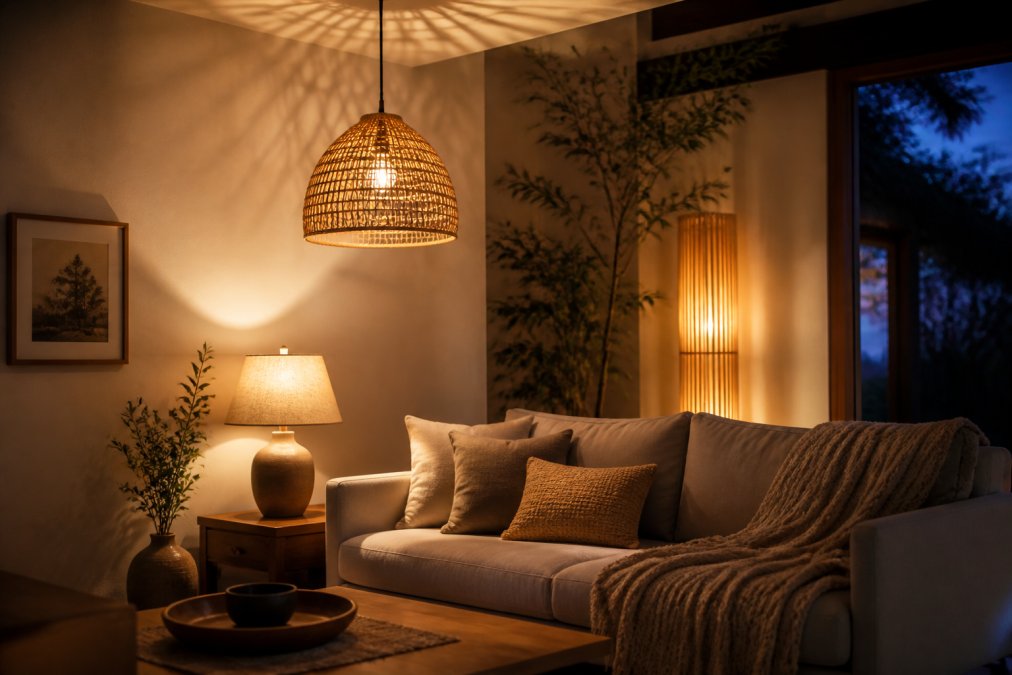
Natural materials do this particularly well. The International WELL Building Institute guidance on lighting quality notes that glare control and light distribution are among the most commonly overlooked factors in residential comfort, and diffused sources score far better than exposed ones.
Look for shades that sit below eye level when seated, so the bulb itself is never in your line of sight. Rattan, bamboo, linen, and paper all soften output while adding texture that reads as warm even when the light is off.
Step 4: Add Smart Home Lighting Automation on Any Budget
Smart home lighting automation lets you dim, schedule, and warm your lights without rewiring. The cheapest route is a smart plug on an existing lamp; the most flexible is a smart bulb with adjustable colour temperature. Most guides stop there, what they rarely explain is which protocol to pick, what it costs, and how to build an evening routine that actually runs itself.
Pick Your Protocol Before You Buy Hardware
Three options dominate the budget end of the market, and the choice locks in what you can automate later:
- Wi-Fi plugs and bulbs connect straight to your router. No hub, cheapest entry point, but each device eats a little bandwidth and cheap models can drop off the network.
- Zigbee or Thread bulbs need a hub or a compatible smart speaker, but they form a mesh that stays reliable as you add devices and respond faster to schedules.
- Bluetooth-only bulbs are the cheapest of all but usually can't run schedules without your phone nearby, which defeats the point of automation.
For a renter starting out, a Wi-Fi smart plug on an existing lamp is the lowest-risk first step: nothing is fixed to the wall, and it comes with you when you move.
A Realistic Budget Breakdown
You do not need to spend much to automate a single room. A basic smart plug typically runs €10-€20, a dimmable warm-white smart bulb €15-€30, and a starter hub (only needed for Zigbee or Thread) €30-€60. Automating one living room with two plugs and one bulb usually lands under €60, less than a single designer floor lamp.
Build an Evening Scene That Runs Itself
Automation is less about the hardware and more about the routine. A simple, reliable evening setup:
- At sunset, trigger table and floor lamps to 2700K at 60% brightness.
- At 20:00, drop the ambient ceiling light to 40%.
- At 22:00, dim accent lights to 15% and shift any tunable bulbs toward 2200K.
- At bedtime, fade everything out over 30 minutes rather than cutting to black.
Most smart apps let you chain these into one tap or a single time-based scene, so the room warms on its own as the evening progresses. If you use a voice assistant, a single spoken phrase can trigger the whole sequence.
Many people find that a single scheduled evening scene does more for ambiance than any individual fixture. Budget-friendly automation is less about the hardware and more about the routine you build around it.
Step 5: Light Each Room for Its Purpose
Room-specific lighting works on the same three-layer principle but shifts the balance. A living room leans on accent and ambient; a bedroom leans on warm, low task light. The gap most guides leave open is what to do when you cannot touch the ceiling, which is the situation for most renters and anyone in a small space.
Living Room: Build a Relaxed Focal Point
Anchor the room with one statement piece, then support it. A woven pendant such as the Éclat Rotin hanglamp (€182.95) creates a relaxed focal point with its open rattan weave, spreading patterned light across the ceiling rather than a single bright spot. Pair it with a floor lamp for ambient fill and a small table lamp for task light, and dim all three in the evening. Aim for the 60/25/15 ambient-task-accent split so no single source dominates.

Bedroom: Layer for Wind-Down and Sleep
Keep the bedroom under 2400K wherever possible. A bedside table lamp on a dimmer handles reading; a low floor lamp in the corner replaces the ceiling light entirely after dark. Avoid overhead fixtures at night, since they flood the room and undo the calm you've built. If your ceiling light is the only fixture and it is not dimmable, a plug-in dimmer between the lamp and the socket is a reversible fix that needs no wiring.
Renter-Friendly and Small-Space Configurations
When you cannot change ceiling fixtures, build the layers from the floor up:
- Corner floor lamp with an upward-facing shade bounces light off the ceiling to fake ambient light without a pendant.
- Two or three small table lamps at different heights create the overlapping pools that make a room feel layered.
- A cordless, rechargeable lamp such as the Lucille Sverriëne tafellamp (€62.95) works on a balcony, in a corner, or anywhere without a nearby socket, useful in rentals where outlets are sparse.
- Plug-in dimmers and smart plugs let you control brightness and scheduling without touching the wiring.
In a small room, resist the urge to add more light. Two well-placed warm sources at different heights usually read as cozier than four competing ones, because the eye has somewhere to rest.

If you can't change the ceiling, change the floor. A corner uplight plus two table lamps at different heights reproduces the layered effect of a professionally lit room without a single permanent fixture.
Common Mistakes That Kill Cozy Home Lighting
The most common mistake is treating brightness as the goal. Cozy rooms are not dim for the sake of it; they're layered, so the eye has somewhere to rest and somewhere to focus.
Other repeat offenders:
- One ceiling light doing all the work. It flattens the room and casts shadows in the wrong places.
- Cool white bulbs in living spaces. Anything above 3000K fights the warmth you're trying to build.
- Exposed bulbs at eye level. Instant glare, instant loss of comfort.
- No dimming. Without a dimmer, you're stuck at one brightness all evening.
- Mismatched colour temperatures. Two bulbs at different Kelvin ratings in one sightline look like an error.
Fix these five and most rooms improve without buying anything new.
Knowing how to create cozy home ambiance lighting takes more than one good lamp. It takes layered sources, warm colour temperatures, diffused shades, and controls that let the light change with the evening. Nuits builds fixtures around exactly that idea: natural materials like rattan, bamboo, and linen, tested for how the light actually falls. Every order ships free across the Benelux, comes with a 30-day money-back guarantee, and carries a 4.7/5 rating from 4,400 reviews. Start with one piece, like the Tissé Naté hanglamp (€82.95) or the Équilibre vloerlamp (€202.99), and build the layers from there. Add to Cart and see the difference warm, diffused light makes.

Frequently Asked Questions
What color temperature is best for cozy home lighting?
Warm white bulbs between 2200K and 2700K give the softest, most inviting glow, similar to candlelight or sunset. Cool white at 4000K and above feels clinical and is better suited to workspaces. To create cozy home lighting, keep living rooms and bedrooms at 2700K or lower, and save brighter temperatures for kitchens or studies where focus matters.
How can I layer lighting to create a cozy atmosphere?
Use three layers: ambient light from a ceiling fixture or floor lamp for overall soft illumination, task lighting from a table lamp or reading light for specific activities, and accent lighting such as candles or a small pendant to add depth and shadow play. Dim each layer separately so you can shift the mood from bright and functional to warm and relaxed in the evening.
Can smart lighting help improve home ambiance in a rental?
Yes. Plug-in smart plugs and Wi-Fi bulbs need no rewiring, so renters can automate lamps, set warm scenes and schedule dimming without touching the walls. You can link a floor lamp and a table lamp to one routine that fades to 2200K at 9pm, then pack everything up when you move out.
How do I choose the right lamps for a small living room?
In small rooms, pick fixtures that bounce light off walls and ceilings instead of glaring straight down. A woven pendant like the Éclat Rotin (€182.95) spreads a playful, diffused glow, while a slim floor lamp such as the Équilibre (€202.99) adds height without taking floor space. Keep total lumens moderate, around 400-800, so the room feels intimate rather than dim.

